

Running Turns, Stop and Reattach
With @cognipeer/agent-server 0.3.0 or later a turn is a run: it goes on when the page that started it closes, reloads or loses its connection. Chat is built on that.
New in 0.4.0
Reattach after a reload, following a turn another window started, a Stop that cancels on the server, notices that say why an answer ended, status badges in the history and the composer states. The server side (runtime, event log, recovery) is in Runs, Cancel & Reattach.
You need nothing to switch on: if the transport has the run methods (AgentServerClient does), Chat uses them. Against an older server, or a transport without them, everything behaves as before.
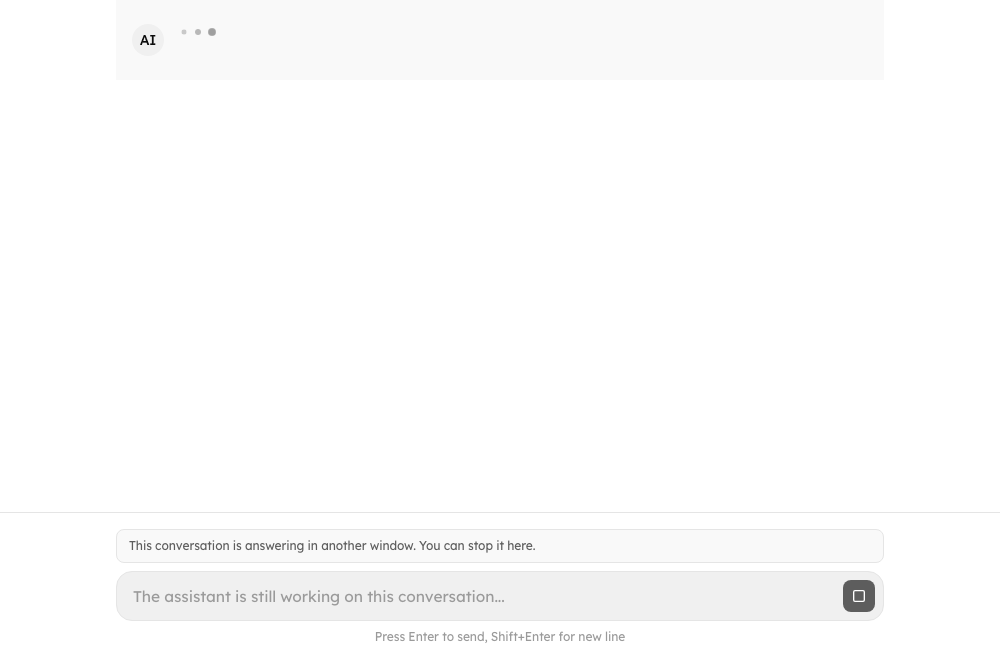
| Reload in the middle of a turn | The conversation opens, sees that a turn is still running and follows it: tool calls and text appear as they happen, then the stored answer replaces them. |
| A turn running in another window | A conversation opened or reloaded while that turn runs follows it the same way. The composer says the conversation is answering elsewhere, and offers Stop. |
| A dropped connection | Not an error. The turn goes on without the page, so the page looks again: it follows what is still running, or shows what finished. Only a conversation that cannot be reached shows a message. |
| Stop | Stops the run on the server, not just this page's connection: tools stop running and spending stops. What was written so far is kept as an answer marked "Stopped". |
| Why an answer ended | A notice under the answer says when it was stopped, hit a limit, used up the conversation's usage limit or failed. |
| History | Rows that are working, waiting for you or stopped on their usage limit carry a badge. |
Reattach
<Chat baseUrl="/api/agents" agentId="assistant" /> // nothing to switch onGET /conversations/:id carries conversation.runtime:
{ "status": "running", "stopReason": null, "lastEventSeq": 41, "pendingActionIds": [], "activeRunId": "run_x1" }When status is running, useChat calls transport.followEvents(conversationId, { after: runtime.lastEventSeq }), which reads GET /conversations/:id/events/stream (Server-Sent Events). The events are folded into the same live view an own turn has: streamed text (agent.message.delta), tool calls (agent.tool_use / agent.tool_result), and the finished agent.message. Live text is not stored, so a page that joins a run in progress would see only the words that come after it joined; the server therefore starts the stream with a snapshot (below). When session.status_idle arrives the conversation is loaded again, and that is what stays: the stored answer, the cards of a pause (requires_action), the stop notice.
- If the stored answer is not there yet at the first look, the page looks once more after
followSettleRetryMs(default 1500). - Opening another conversation, starting a new chat or unmounting stops following (the run itself goes on).
- A send refused with
conversation_busyloads the conversation again, which follows the turn that is running. - Coming back to a conversation whose turn this page started and left picks that turn up again.
useChat returns isFollowing. While it is true isStreaming is true too, so the message list draws the live turn exactly as it draws an own one, and composerState is "following".
The follow stream
AgentServerClient.followEvents reconnects by itself. A closed stream is opened again from the last event seen (?after=<seq>), with backoff, and a refusal retrying cannot fix (404, 403) is thrown. Tune it:
new AgentServerClient({
  baseUrl: "/api/agents",
  reconnect: { retries: 6, delayMs: 500, maxDelayMs: 8000 },
});Frames that carry no seq (agent.message.delta, live text that is not stored) are delivered too; a follower built only on the stored events loses nothing.
The reattach snapshot
When a client connects to GET /conversations/:id/events/stream while a run is active, the server first sends one frame that is not part of the log (no id: line, so the cursor does not move), then the replay and the live frames:
event: agent.message.snapshot
data: {"type":"agent.message.snapshot","data":{"run_id":"run_x1","text":"<what the run has written so far>","user_message":{"id":"u7","content":"...","files":[]}}}user_message is the message that started the run, or null. Chat seeds the live bubble with text, and adds the person's own message to the transcript when the stored history does not have it yet (the stored history of a conversation that is still answering may not include it); the live agent.message.delta frames that follow are appended. The same frame comes again after a reconnect and replaces the text (it holds everything written so far, so nothing is doubled), and the session.status_running of the run the snapshot belongs to, if the replay still reaches it, does not wipe the text. That start usually names no run (agent-server stamps neither the frame nor its data), so the text is kept while the start names the snapshot's run or none at all; only a different run (named on a start, or on the run_id of a delta) or a start after session.status_idle begins the view afresh. A server that sends no snapshot works as before.
The events Chat UI reads
Frames are { seq?, type, data, runId?, createdAt? }; data is the Console's snake_case. Unknown types are ignored, so a newer server does not break an older page.
type | What the follower does |
|---|---|
session.status_running | A turn begins: the live view starts afresh (except right after a snapshot of the same run, see above) |
agent.message.snapshot | Seeds the live text with data.text, and adds the person's own message from data.user_message when the stored history lacks it. Not stored: no seq |
user.message | Remembers the person's message of the followed turn (message_id, content, files) |
agent.message.delta | Appends data.text to the live text. Live only: no seq |
agent.tool_use | Shows a tool call (tool_call_id, name, args) |
agent.tool_result | Marks the call finished (ok: false with an error marks it failed). The result itself is not in the log |
agent.message | The finished answer (message_id, content); used as the text only when nothing was streamed |
session.error | The run failed (message, code) |
session.status_idle | The turn is over (stop_reason, detail, pending_action_ids): the conversation is fetched again and its stored state replaces the live view |
Stop
stop() (the Stop button) does three things when the transport has cancel:
- closes this page's own stream,
- calls
POST /conversations/:id/cancel, - shows the partial answer at once as a message marked stopped, then replaces it with what the server kept.
While the page is following a turn that runs elsewhere, Stop asks the server to cancel it and the follower sees the run end.
A server without the cancel route (an older one) answers 404; that is ignored and Stop closes the connection, as in 0.3.0. Any other refusal is shown. A transport without cancel (Chat Completions, Responses, A2A, in-process agent-sdk) keeps the old behaviour: closing the connection is all there is.
Stop also works while the files of a message are still going up: the upload is aborted, the message is taken back and the files return to the composer.
Why an answer ended
An assistant message carries status and, where the server says, stopReason (also read from metadata.stopReason):
stopReason | Notice |
|---|---|
end_turn, requires_action | none (a pause shows its cards) |
cancelled | "Stopped before it finished." |
limit | "The assistant reached a limit and stopped." |
max_turns | "The assistant used up its allowed steps and stopped." |
budget_reached | "This conversation reached its usage limit." (the usage limit banner explains the rest) |
error | "Something went wrong and the assistant stopped." |
A conversation that ends on the person's own message while the runtime says it stopped on an error (the run that was answering was cut off, say by a restart, before it wrote anything) shows "The reply was interrupted" under that message, with Retry. Retry sends the same text again, with the files the message carried (they are stored in the conversation already; one that has expired is left out). It is the same notice, InterruptedNotice, and renderStopNotice receives it with stopReason: "error" and an onRetry to call. A transcript (readOnly) shows the sentence without the button. useChat returns interrupted and retryInterrupted().
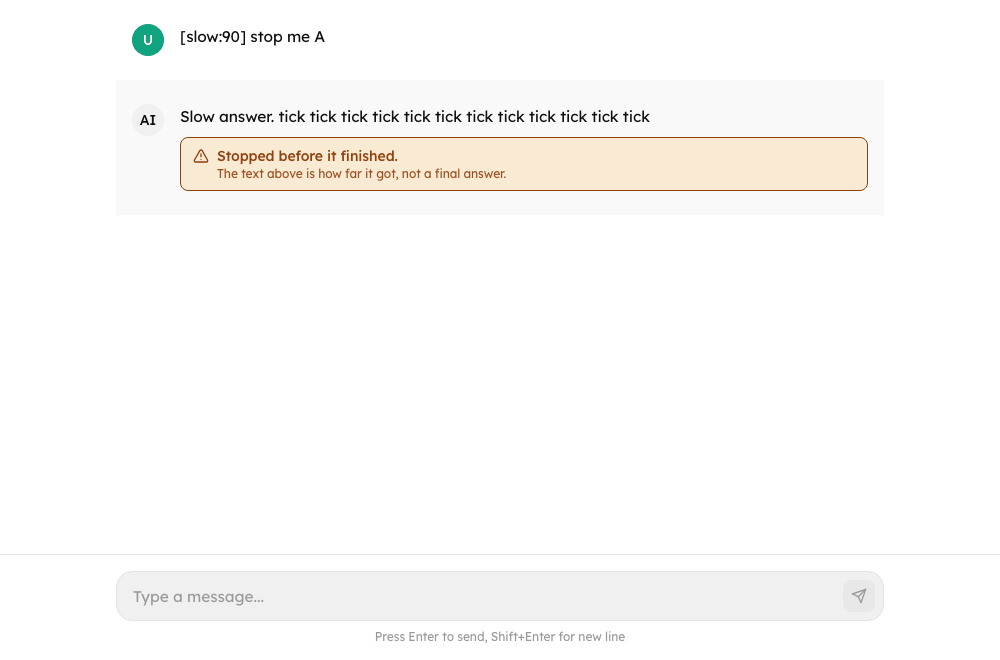
A message that is incomplete or cancelled without a reason still says so. Under a stopped answer the notice adds whether the text above is a partial answer or nothing was written. The runtime's own wording (stopDetail) is not shown to end users; it reaches renderStopNotice:
<Chat
  renderStopNotice={({ stopReason, detail, hasText }) =>
    stopReason === "limit" ? <MyLimitNotice detail={detail} /> : null
  }
/>Return null from the function to show nothing for a reason. The same notice is MessageStopNotice, for custom message lists.
Warnings. A turn that completed but is worth a remark (file_truncated, file_unreadable, images_not_supported, pause_state_too_large) lists it under the answer, from metadata.warnings, in the page's language. A code the page has no string for shows the server's own message.
History badges
ConversationListItem.runtime comes with the list (GET /conversations). ChatHistory shows a badge on:
runtime.status | Badge |
|---|---|
running | Working |
requires_action | Waiting for you |
budget_paused, or a spent usage limit | Limit reached |
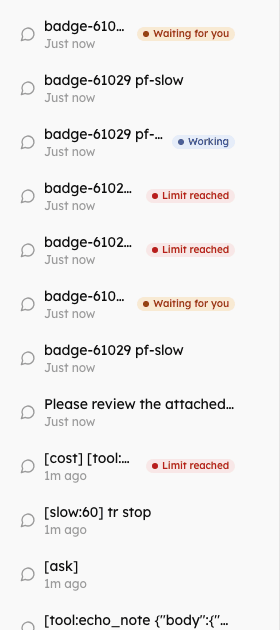
The selected conversation shows what this page knows (it may be ahead of the list), and the list is fetched again whenever a turn ends. showStatus={false} turns the badges off.
Every row is a real <button>: Tab, Enter and Space work, the arrow keys, Home and End move between rows, Escape closes the sidebar where it is an overlay, and the delete button is visible as soon as the row has keyboard focus.
The composer
One value says what the composer is doing: useChat returns composerState, and ChatInput takes it as state.
| State | When | Textarea | Paperclip | Stop |
|---|---|---|---|---|
open | nothing is in the way | open | on | while a turn runs |
blocked | a card waits and the agent wants it answered first | closed | off | |
cancel | a card waits and a new message cancels it | open, with a warning | on | |
answer | a lone free-text question: the composer answers it | open, with a notice | on | |
following | a turn runs somewhere else | closed | off | yes |
budget_paused | the usage limit is used up | closed | off | |
readonly | the host set readOnly | closed | off |
pendingMode on ChatInput still works for the first three.
Reading the agent
GET /agents carries what each agent takes. Chat reads it with this precedence, per field: capabilities.attachments, then the older metadata keys, then the props.
{
  "id": "vision",
  "capabilities": {
    "attachments": { "enabled": true, "maxFiles": 3, "maxFileSize": 10485760, "allowedMimeTypes": ["image/*"], "acceptsImages": true, "retentionDays": 30 },
    "approvalArgsEdit": true,
    "budget": { "allowContinue": true, "allowEdit": false }
  },
  "metadata": { "pendingActionComposerMode": "cancel" }
}resolveAgentSettings(agent, defaults) is the function that does it, exported for custom layouts.
Other transports
useChat degrades by transport. Without followEvents there is no reattach, without cancel Stop closes the connection, without continueConversation / updateBudget the usage-limit banner explains but cannot act, without listFiles the number of files a conversation holds is counted from the loaded messages, without getFileUrl images of a loaded conversation show only when the file has a url. See Transports for what each backend supports.
Troubleshooting
| Symptom | Cause and fix |
|---|---|
| A reload in the middle of a turn shows nothing new | The server does not report runtime (older than agent-server 0.3.0), or the transport has no followEvents. Check that GET /conversations/:id carries runtime.status: "running". |
| The live text is replaced after a reconnect | Expected: a reconnect starts with a fresh snapshot that holds everything written so far, and it replaces the live text instead of being appended to it. Nothing is doubled. |
| "The connection to the running conversation was lost. Reload to see where it stands." | The follow stream kept failing (more than reconnect.retries times in a row) or the server refused it (404, 403). Reload the page; the stored conversation shows where the turn stands. |
| Stop does nothing on the server | The transport has no cancel (Chat Completions, Responses, A2A, in-process agent-sdk): Stop closes the connection only. On agent-server a 404 from the cancel route (an older server) is ignored the same way. |
| An answer says "Stopped" but a longer one appears afterwards | The page showed what it had received; once the server answered the cancel, the stored answer replaced it. |
| The proxy buffers the stream | Follow and stream responses are Server-Sent Events: turn buffering off for text/event-stream (for nginx, proxy_buffering off), or the text arrives in one piece at the end. |