

Usage & Budgets
The server reports what every turn used and, when it knows the prices, what it cost. A conversation can have a budget: a limit on what its turns cost in total. When it is used up the turn stops, the conversation waits, and a person can raise the limit and carry on.
Nothing here changes an agent that has no pricing: it reports tokens as before and has no budget.
New in 0.3.0
usage is now this turn's own usage (a turn resumed after an approval no longer repeats the calls before the pause), cachedInputTokens and costUsd appear when known, and pricing, budget, authorizeBudget, conversation.spentUsd and POST /conversations/:id/continue are new. See Upgrading to 0.3.0.
When to use it
- You expose agents to people you do not control and want a ceiling on what one conversation can cost.
- You want a cost figure per turn (
usage.costUsd) and per conversation (spentUsd) to show or to bill. - You want a person with the right to do so (your
authorizeBudgethook) to raise the limit and let a stopped turn carry on, instead of starting over.
Without pricing nothing is priced and budgets cannot be used; the rest of the server is unaffected.
Usage of a turn
usage on a message response, on stream.done and in the session.usage event is what this turn used:
{ "inputTokens": 1200, "outputTokens": 310, "totalTokens": 1510, "cachedInputTokens": 800, "costUsd": 0.0123 }An agent-sdk agent reports its usage as a ledger: one entry per model call and totals per model, cumulative over the life of a state. A turn that paused for an approval and was resumed hands back the ledger of the whole turn, the calls before the pause included. The server subtracts the ledger the run started from, so each run reports only what it used itself: the message that paused reports the calls up to the pause, the answer that carried the turn on reports the calls after it, and nothing is counted twice. Chat Completions and Responses API agents report their provider's usage; a custom handler returns usage: { inputTokens, outputTokens, totalTokens } and may add costUsd (what the turn cost) or model (so the server can price the tokens). A host-backed agent does the same with usage events or the usage of its result. Neither a handler nor a host agent can be stopped in the middle of a turn by the budget (there is no cap to hand it): the turn that crosses the budget completes and the next message is refused.
Prices
costUsd needs to know what a token costs. Give the server a pricing function - model name in, price per token out:
import { createAgentServer } from '@cognipeer/agent-server';

createAgentServer({
  basePath: '/api',
  storage,
  pricing: (model) =>
    model === 'gpt-4o' ? { inputPerToken: 2.5e-6, outputPerToken: 10e-6, cachedInputPerToken: 1.25e-6 } : undefined,
});A token is priced as (input - cached) x inputPerToken + cached x (cachedInputPerToken ?? inputPerToken) + output x outputPerToken, where cached is cachedInputTokens (which is part of inputTokens). Prices are USD per token, so 2.5e-6 is $2.50 per million.
The model name is the one agent-sdk reports in its ledger (Chat Completions / Responses agents: the model of their config). A model pricing returns undefined for is not priced; if none of a turn's models is priced there is no costUsd and the turn adds nothing to the conversation's total. One agent can have its own prices: server.registerSDKAgent(id, agent, info, { pricing }).
The conversation's total is conversation.spentUsd (and spentUsd next to usage on every response). It grows with every priced turn, whether the conversation has a budget or not, and counts a turn that was cancelled.
Budgets
createAgentServer({
  basePath: '/api',
  storage,
  pricing,
  budget: { maxCostUsd: 5, onReach: 'pause' },   // every new conversation starts with it
});

// one agent can differ ...
server.registerSDKAgent('research', agent, {}, { budget: { maxCostUsd: 50, onReach: 'stop' } });
// ... or have none
server.registerSDKAgent('cheap', agent, {}, { budget: null });A budget needs prices: a budget on an agent nothing can price is refused when the agent is registered (and 400 budget_unavailable when a client asks for one).
onReach | When the limit is reached |
|---|---|
pause (default) | the conversation waits. runtime.status is budget_paused. Raise the budget, then POST /conversations/:id/continue carries the stopped turn on (when the turn was cut short; see continuable below). |
stop | the conversation ends: runtime.status is idle, nothing is kept to carry on from, and every further message is refused until the budget is raised. |
What happens when it is reached
Before a turn (a message, an answer that lets the agent run again, a continuation): if nothing is left, the model is not called and nothing is stored:
402 budget_reachedwitherror.details: { spentUsd, maxCostUsd, onReach }.During a turn: agent-sdk is given the room that is left as its own
limits.maxCostUsdand stops before the next model call once the turn's cost is above it, so a turn overshoots by at most one model call. agent-sdk can only price its calls if the agent was built with acostEstimator; use the same prices:typescriptimport { costEstimatorFromPricing } from '@cognipeer/agent-server'; const agent = createSmartAgent({ model, tools, costEstimator: costEstimatorFromPricing(pricing) });Without one the SDK's cost limit does nothing and the budget applies between turns: the turn that crosses it completes, and the next one is refused.
After a turn: the cost is added to
spentUsd. A turn the budget stopped, or that finished above it, ends withstopReason: "budget_reached"; the events arebudget.reached{ spent_usd, max_cost_usd, on_reach }andsession.status_idle{ stop_reason: "budget_reached" }. A turn the budget cut short isincomplete; one that only crossed the line keeps its answer and iscompleted. A turn that paused for a person or was cancelled keeps its own stop reason (the next turn is refused all the same).A task cut short by its budget fails; one that only crossed it completes.
Raising it, and carrying on
PATCH /conversations/conv_1
{ "budget": { "maxCostUsd": 20, "onReach": "pause" } }     # or "budget": null to remove it

POST /conversations/conv_1/continue # { "stream": true } to streamLowering a budget is the owner's to do. Raising or removing one (a higher limit,
pausewhere it wasstop,null) goes through theauthorizeBudgethook, and without it the answer is403 budget_forbidden:typescriptcreateAgentServer({ // ... authorizeBudget: (ctx, { conversation, current, requested, spentUsd }) => ctx.data.role === 'admin', });A new limit has to be above what the conversation has spent (
400 invalid_budget). The same rules apply tobudgetinPOST /conversations, measured against the agent's default.continueresumes the agent from the state the budget stopped it in, with no new message; the continuation is a new assistant message and only reports what it used itself.402 budget_reachedwhile the budget is still used up,409 action_pendingwhile the conversation waits on a person,409 nothing_to_continuewhen there is nothing to carry on (onReach: "stop", a turn that only crossed the line, or the turn was already carried on). Only agent-sdk agents can be continued: the stopped state is kept next to the conversation's pause state and counts againstlimits.maxStateBytes.A new message instead of
continuediscards the stopped state and starts a fresh turn.
continuable tells a client whether there is a stopped turn to carry on. GET /conversations/:id, the conversations list and the PATCH answer carry it next to runtime:
| The last turn | runtime.status | continuable | After a raise |
|---|---|---|---|
was cut short by the budget (incomplete, onReach: "pause") | budget_paused | true | still budget_paused and true: POST .../continue resumes it, or a new message gives it up |
| finished its answer, and crossed the limit | budget_paused while the budget is used up | false | idle, false: the raise only reopens the conversation, there is nothing to carry on |
| was carried on, or superseded by a new message | idle | false |
A client's "Increase and continue" is therefore: PATCH the budget, call continue only if the answer says continuable: true, then read the conversation again (spentUsd, runtime). Before continuable existed a client had to guess from runtime.status, and a raise turned a cut-short turn's budget_paused into idle, which looked like nothing to continue.
Every conversation shows budget and spentUsd (GET /conversations, GET /conversations/:id), and runtime.status is budget_paused while it waits on its budget.
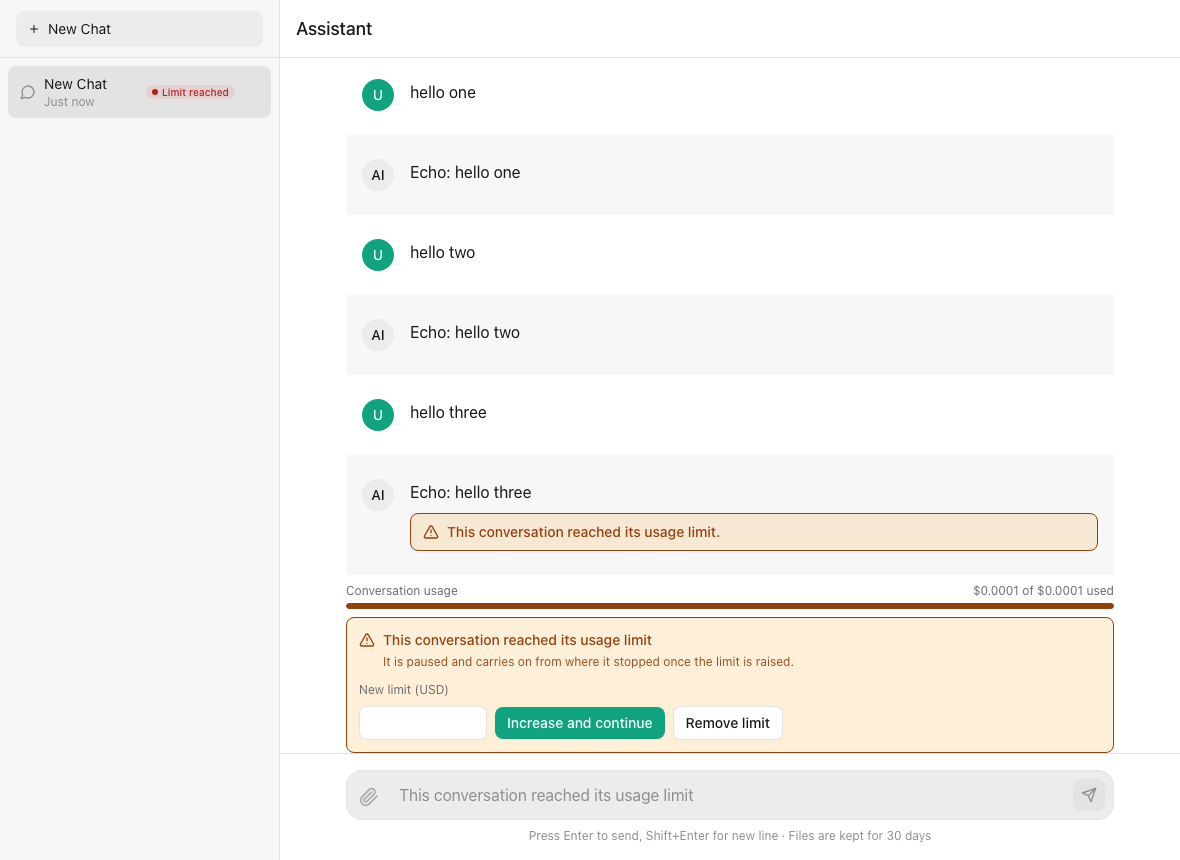
A conversation that used up its budget (onReach: "pause"), shown by @cognipeer/chat-ui against the standalone example: runtime.status is budget_paused; "Increase and continue" is a PATCH of the budget followed by POST .../continue when continuable is true.
Where it is kept
The budget and the total live in the conversation's internal state, next to the pause state, and are written together with the turn they belong to. They are written with a compare-and-set, so a budget change while a turn runs, or two turns' bookkeeping, never overwrite each other. A conversation inherits its agent's budget until something is written to it; after the first priced turn it keeps its own copy.
Troubleshooting
| Symptom | Cause and fix |
|---|---|
No costUsd on responses | pricing returns undefined for the model name the agent reports (agent-sdk's ledger name; for Chat Completions / Responses agents the model of their config). Log the name you receive and return a price for it. |
createAgentServer or register*Agent throws "has a budget but no pricing" | A budget (server or agent) needs a pricing function, the server's or the agent's. |
400 budget_unavailable on create or PATCH | The conversation's agent has no pricing, so a budget cannot be counted against. |
403 budget_forbidden when raising | Raising or removing a budget needs the authorizeBudget hook; without it nobody but your own code can lift a limit. |
400 invalid_budget | Not a valid budget, or a limit at or below what the conversation has already spent. |
| The turn overshoots the limit | agent-sdk stops before the next model call, so a turn overshoots by at most one call; without costEstimatorFromPricing as the agent's costEstimator the SDK cannot price its calls and the budget applies only between turns. Handlers and host agents are never stopped in the middle. |
POST .../continue is 409 nothing_to_continue | There is no stopped turn: onReach: "stop", the turn only crossed the limit after finishing its answer, or it was already carried on. Send a new message instead. |
| "Increase and continue" does nothing | Call continue only when the PATCH answer says continuable: true; read the conversation again afterwards (spentUsd, runtime). |
Next Steps
- Runs, Cancel & Reattach -
runtime.status: "budget_paused"and thebudget.reachedevent - Host-backed agents - reporting usage from your own backend
- Embedding & limits - rate limits and the other caps the host owns
- REST Endpoints - the continue route